The 10 Hottest Cities in the U.S.
Key takeaways
- Phoenix, Yuma, and Las Vegas are the hottest cities in the U.S., where summer temperatures regularly top 100°F
- The nation’s hottest cities are clustered in the desert Southwest and the Rio Grande Valley in Texas—the hottest state in the country.
- As the climate warms and heat waves become more common, preparing for extreme weather is essential, especially if you’re planning on moving.
The past eleven years have been the hottest in human history. Each year has either broken or approached the previous year’s record, affecting climates in every corner of the globe. So far this year, nonstop heat domes have brought historic heat to nearly every continent on the planet.
Even so, warm, sunny weather continues to be the top reason people choose to move. But as temperatures continue to rise, climate risk is becoming an increasingly important factor. Whether you’re looking for year-round sunshine or hoping to avoid extreme heat, understanding which cities are the hottest can help inform your search.
Redfin compiled a list of the hottest cities in the U.S. to help guide your decision. Read on to see which cities top the list, why they’re so hot, and what to consider before making a move.
The hottest cities in the U.S.
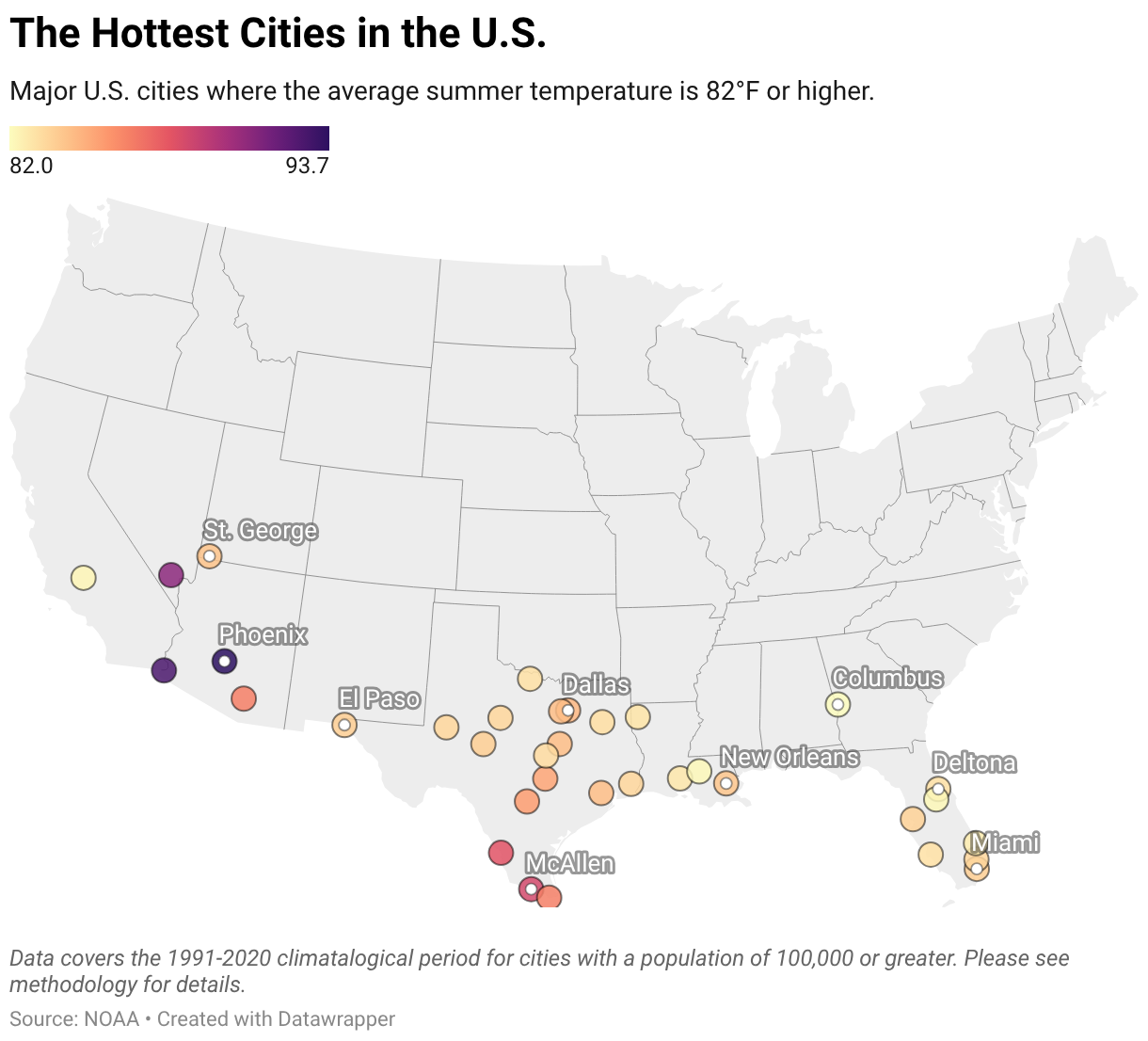
Phoenix, Yuma, and Las Vegas are the three hottest cities in the U.S., followed by three cities in the Rio Grande Valley. All ten of the hottest cities are located in the Southwest and Texas, in or near some of the hottest deserts and bodies of water in the world.
| City | Average summer temperature | Average annual temperature | Record highest temperature (year recorded) |
| Phoenix, AZ | 93.7°F | 75.4°F | 122°F (1990) |
| Yuma, AZ | 92.8°F | 75.9°F | 124°F (1995) |
| Las Vegas, NV | 90.8°F | 70.1°F | 120°F (2024) |
| McAllen, TX | 88.5°F | 77.4°F | 111°F (2023) |
| Laredo, TX | 88.0°F | 74.6°F | 115°F (1908, 1927, 1942, 1985, 2023) |
| Brownsville, TX | 86.4°F | 76.2°F | 106°F (1984, 2023) |
| Tucson, AZ | 86.4°F | 69.7°F | 117°F (1990) |
| San Antonio, TX | 85.4°F | 71.1°F | 111°F (2000) |
| Austin, TX | 85.1°F | 70.0°F | 112°F (2000, 2011) |
| Dallas, TX | 84.5°F | 68.0°F | 113°F (1980) |
If we measured instead by average annual temperature, Honolulu would top the list (78°F), followed by McAllen (77.4°F) and Miami (77.4°F).
Why are these cities so hot?
The hottest cities in the U.S. are almost all located in the Sun Belt—a region spanning the entire southern third of the country. The Sun Belt is so hot because it’s closer to the equator, deserts, and warm bodies of water.
Phoenix, Yuma, and Las Vegas in particular are so hot because they’re located in the rapidly warming Sonoran and Mojave deserts. Meanwhile, McAllen, Laredo, and Brownsville sit in the notoriously hot Rio Grande Valley (the RGV)—a region where the heat of the Chihuahuan Desert meets the humidity of the Gulf of Mexico.
Many of the hottest cities in America have seen record-breaking heat in recent years. Phoenix recorded its two hottest years on record in 2024 and 2025, while Las Vegas broke its all-time heat record in 2024 when temperatures reached 120°F. Brownsville and Laredo also experienced record heat in 2023.
Texas as a whole has warmed exceptionally quickly, becoming the hottest state in the country. Triple-digit heat has become the norm, with average temperatures now 6–12°F above normal. In the past ten years, there have been 1,000 more days of record-breaking heat than in a typical decade.
Despite the heat, many of these areas continue to attract residents looking for sunshine and affordability. For example, Las Vegas’ metro’s population has nearly doubled since 2000, and Phoenix has been one of the fastest-growing cities in the country since 2010. The challenge for people living in these regions is adapting their homes and daily routines to hotter summers.
What is the hottest place in the U.S.?
Death Valley National Park is the hottest place in the U.S. The desert basin has an average summer temperature of 101.3°F and an average summer high of 114.8°F.
Not only is Death Valley the hottest place in the country, but it’s also seen the hottest temperatures ever recorded on Earth. The park hit 134.0°F in 1913, which is recognized as the hottest temperature in human history (although this has been disputed). It also saw the world’s second-hottest temperature of 130°F in 2020 and 2021 (unverified).

Why heat risk matters when choosing where to live
Temperature is only one part of understanding a city’s climate. Extreme heat can affect everything from daily routines and water availability to household expenses and personal safety—especially during the hottest months of the year.
Homes in hot climates often require features that help manage heat, such as efficient air conditioning systems, strong insulation, energy-efficient windows, shade coverage, and outdoor spaces designed to provide relief from the sun.
If you’re considering a move, you can use Redfin to understand a home’s climate and weather risks. Simply click on any property to see its heat, flood, fire, wind, and air quality risks, as well as average monthly temperatures, average precipitation, and typical daily sunshine. Redfin partners with the Weather Company, Shadowmap, and First Street (now owned by MSCI) to display this data for nearly every property in the U.S.
>> Read: Where Should I Live? 10 Questions to Help You Decide
How to prepare for extreme heat
As record-breaking temperatures become more common, it’s essential to take heat seriously, especially in the country’s hottest cities. Whether you’re renting or owning a home, small changes can help make extreme heat safer and more manageable. Here are a few tips:
- Keep your home cool: Use fans, blackout curtains, and air conditioning if available. Even a few degrees of improvement can make a big difference during a heat wave. If you have AC, make sure to keep it maintained by replacing filters and getting it serviced.
- Improve your home’s efficiency: Energy-efficient windows, proper insulation, and shade from trees or exterior coverings can help keep indoor temperatures comfortable and reduce cooling costs.
- Prepare for power outages: Extreme heat can strain the electrical grid. Keep flashlights, backup batteries, bottled water, and portable fans on hand in case of an outage.
- Avoid peak heat: Stay indoors or in the shade between 10 a.m. and 4 p.m., when temperatures are usually the highest. If you don’t have a way to cool down indoors, find a local cooling center or public space with air conditioning.
- Know the signs of heat illness: Dizziness, confusion, and rapid heartbeat can signal heat exhaustion or stroke. If you see anyone struggling with these symptoms, seek help immediately.
>> Read: Top 8 Home Features for Hot Climates
How are temperatures changing?
Global average temperatures in both 2024 and 2025 surpassed 1.5°C (2.7°F), the threshold above which scientists say will trigger irreversible climate impacts.
This heat continues to fuel more intense, long-lasting heat waves—the deadliest form of extreme weather—along with stronger and more frequent hurricanes, floods, and droughts. Research shows that without major cuts to greenhouse gas emissions, rising temperatures will likely make some locations uninhabitable to humans within the next 50-80 years—forcing communities to either adapt to a new normal or move.
Tropical and coastal areas face the greatest risk of unbearable heat due to their high humidity, which can lead to extremely high heat indices (“feels like” temperatures). This is why Southeastern and Southwestern U.S. cities have the highest heat risks in the country.
Methodology
To determine the “hottest” cities, we ranked U.S. metropolitan areas with populations over 100,000 based on their average summer temperature. This way, we account for metros with hotter summers and cooler winters, rather than favoring tropical places that are warm year-round. We also included each metro’s average annual temperature, though it didn’t factor into the rankings.
An average summer temperature combines a city’s average daily high and low temperatures from June-August. An average annual temperature combines a city’s average daily high and low temperatures from January-December.
Data comes from the National Centers for Environmental Information (NCEI) and its parent administration, the National Oceanic and Atmospheric Administration (NOAA). Average summer temperatures are a three-month average based on data from June-August 1991-2020. Average annual temperatures are a twelve-month average based on data from 1991-2020.
The post The 10 Hottest Cities in the U.S. appeared first on Redfin | Real Estate Tips for Home Buying, Selling & More.
from Redfin | Real Estate Tips for Home Buying, Selling & More https://www.redfin.com/blog/hottest-cities-in-the-us/


Nhận xét
Đăng nhận xét