Is It a Buyer’s or Seller’s Market?

Key takeaways:
- It’s a buyer’s market in a majority of U.S. housing markets, meaning home buyers have the upper hand.
- Buyers continue to hold off as economic worries and historic unaffordability keep them on the sidelines.
- The Sun Belt is home to the strongest buyer’s markets; the Midwest, Northeast, and Bay Area are home to the remaining seller’s markets.
- Housing markets vary widely, so take into account local market dynamics and talk with an agent to get the full picture.
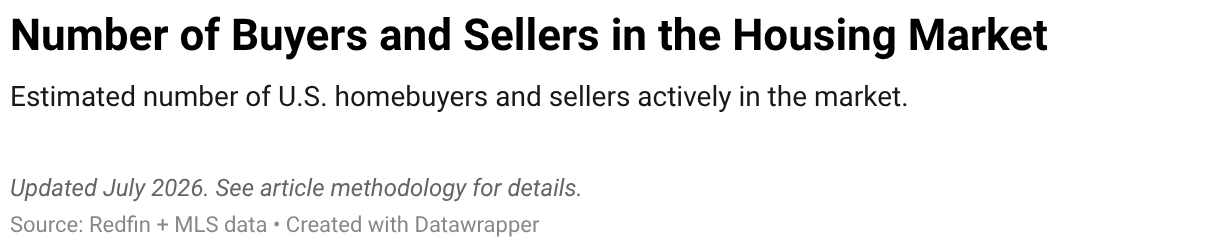
The U.S. is in the strongest buyer’s market on record. Following the pandemic-fueled seller’s market in 2021, sellers now outnumber buyers by nearly 63% – a historic share. In numeric terms, there are an estimated 1.51 million sellers and 929,000 buyers in the market today. Generally, the greater the seller surplus, the stronger the buyer’s market and the more leverage they have.
However, at the core of the housing market is a historic affordability crisis, making conditions feel anything but buyer-friendly. Most consumers are holding off, giving those who can afford to buy more leverage. Sellers are also trickling back into the market as they adjust to the new normal or fear that prices could drop if they wait, widening the gap and strengthening the buyer’s market.
Here’s what to know about buyer’s vs seller’s markets, how to tell which market you’re in, and where each side has the most leverage right now.
What is a buyer’s market vs seller’s market?
Buyer’s market
A buyer’s market happens when there are more homes for sale than buyers to purchase them. When this is the case, buyers typically drive negotiations and are more likely to receive concessions.
Home prices tend to grow more slowly in buyer’s markets than seller’s markets. But if a buyer’s market sees prices cool substantially, the pendulum may swing back toward sellers as more home buyers come off the bench, pushing prices up again.
Seller’s market
A seller’s market occurs when demand exceeds supply. Buyers outnumber sellers, creating more competition and fueling bidding wars. Sellers typically lead negotiations in a seller’s market and see homes sell for above asking. House prices also tend to rise more quickly and sell faster.
The strongest buyer’s markets in 2026
Sellers outnumber buyers by the most in these metros, giving buyers more leverage. Redfin defined a “buyer’s market” as one where sellers outnumbered buyers by at least 10%. In total, 41 out of 50 U.S. metros are buyer’s markets – the most on record.
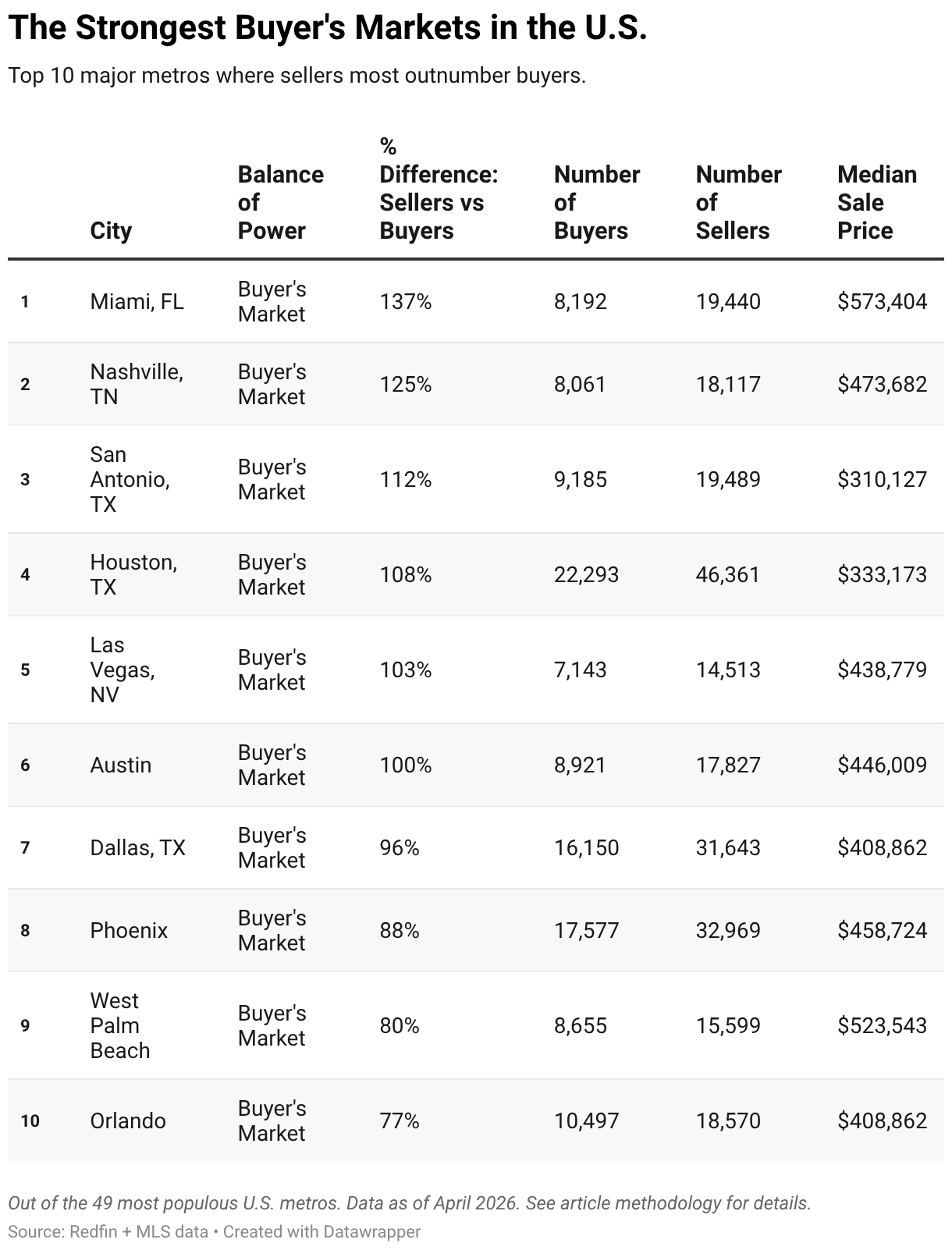
The Sun Belt – cities stretching from the Southeast to the Southwest – is home to all of the nation’s strongest buyer’s markets. Miami sits firmly on top, while Austin is in fourth – ground zero for the cooldowns that have been sweeping pandemic boomtowns since 2022.
The Sun Belt skyrocketed in popularity during the pandemic, when scores of home buyers moved in from more expensive parts of the country, driving up housing costs and pricing many locals out of the market. Now, many of those same markets are among the fastest-cooling in the country.
Housing supply also plays a role. Florida and Texas in particular saw a surge in homebuilding during the pandemic to meet demand, but many of these homes are now sitting unsold as buyers back off. Florida’s housing inventory reached its highest level on record in 2025, with demand dropping due to rising prices, climate risks, and surging insurance costs.
The strongest seller’s markets in 2026
In a handful of metros, buyers still outnumber sellers, giving sellers the edge. Redfin defined a “seller’s market” as one where buyers outnumbered sellers by at least 10%. Only five metros made the cut.

The Midwest and Northeast are home to nearly all of the remaining seller’s markets. Homebuilding and population growth has historically lagged in these regions; with more people looking to move to the region for homes they can afford, supply is falling far short of what’s needed, pushing prices up.
San Francisco has also seen an avalanche of demand recently due to an influx of AI wealth, helping it become a seller’s market for just the third time in four years, as well as the most expensive metro in the nation.
What buyers should do right now
- If you’re buying in a buyer’s market: This is typically the ideal time for buyers to make a move, if they can afford to. Home prices may decline or stagnate, listings stay on the market longer, and sellers are more likely to negotiate. You may see price reductions, seller concessions, or repairs included to close the deal. With less competition, buyers have more leverage to secure a home at a better price.
- If you’re buying in a seller’s market: Sellers hold the upper hand, and competition among buyers can be fierce. Homes often sell quickly and attract multiple offers, which can drive prices well above asking. If you’re buying in a seller’s market, be prepared to act fast and make strong offers; trying to negotiate too aggressively could cost you the home.
>> Read: Is Now a Good Time to Buy a House?
What sellers should do right now
- If you’re selling in a buyer’s market: Selling becomes more challenging when inventory is high and demand is low. Homes tend to sit on the market longer, and homeowners are more likely to offer concessions. Today, the typical home takes 51 days to sell, and almost half of sellers are offering concessions.
- If you’re selling in a seller’s market: This is usually a great time to sell. Homes typically move quickly, and competition among buyers can lead to multiple offers, bidding wars, or offers above asking price. With high demand and limited inventory, sellers have the upper hand and are more likely to get favorable terms, including waived contingencies and minimal concessions.
>> Read: Should I Sell My House Now?
How to tell if you’re in a buyer’s or seller’s market
Even if the national housing market favors buyers or sellers, individual cities and regions usually vary widely. Sometimes, even adjacent neighborhoods will have completely different trends. That’s why it’s important to do your research to understand which way your market leans.
Here are a few ways to stay ahead of the competition.
Check the Redfin Data Center
Redfin publishes its monthly buyers and sellers dynamics research to the newly updated Redfin Data Center for public viewing. On the dashboard, you can see whether the national housing market – and any of the 50 largest metros – leans toward buyers or sellers. This is a good way to get a baseline picture of the housing market and help determine pricing or offers. However, it may not reflect your neighborhood or include your city; that’s where additional research and insight comes in.
Talk with a local agent
Local real estate agents know their market best. They have up-to-date knowledge on how long homes are sitting on the market, whether sellers are cutting prices, and how competitive offers are. An experienced agent can tell you if buyers or sellers have the upper hand and help you make informed decisions in your area.
Research housing inventory
A common way to gauge which way a market leans is to look at “months of supply” – the number of months it would take for available inventory to sell at the current rate. Supply below 4 months tends to favor sellers, while supply above 5 – 6 months tends to favor buyers. Redfin publishes this data on the Redfin Data Center for every metropolitan area in the country.
Track sale price trends
Price growth often accelerates during a seller’s market and cools during a buyer’s market, sometimes even causing home prices to fall slightly. If prices are growing quickly and show no signs of slowing down, you could be in a seller’s market.
Look at mortgage rates
Mortgage rates play a huge role in the housing market. Typically, the higher the rates, the less buyers shop for homes, making sellers more desperate for offers. This is the case today, which is helping put buyers in the driver’s seat but slowing the market to a crawl.
Looking forward
Economic uncertainty continues to throw a wrench into the housing market, with inflation, economic shocks, AI, conflicts in the Middle East, tariffs, and immigration policy all playing a role. Homebuilding is also more expensive than ever, putting pressure on the nation’s aging housing stock.
“Many Americans are facing a historically challenging economy, with financial pressures mounting on multiple fronts that are weighing on consumer confidence and keeping most buyers on the bench,” said Chen Zhao, Head of Economics Research at Redfin. “Even so, there are some bright spots. In part because housing costs are so high and so few homes are selling, price growth has slowed, and in some places, they’re falling. The prolonged seller’s market is over, so buyers with the budget may want to act now while competition is lower and sellers are more willing to negotiate.”
There will be bumps in the road, but Redfin economists expect price growth to slow further and affordability to improve in the coming years.
Methodology
All data covers September 2026 and is seasonally adjusted (except for median sale price), dating back to 2013. Please see this article for the full methodology, and this report for Redfin’s most recent analysis, including a full metro-level breakdown.
The post Is It a Buyer’s or Seller’s Market? appeared first on Redfin | Real Estate Tips for Home Buying, Selling & More.
from Redfin | Real Estate Tips for Home Buying, Selling & More https://www.redfin.com/blog/is-it-a-buyers-or-sellers-market/


Nhận xét
Đăng nhận xét